Synthetic data: Training AI on blockchain-verified datasets
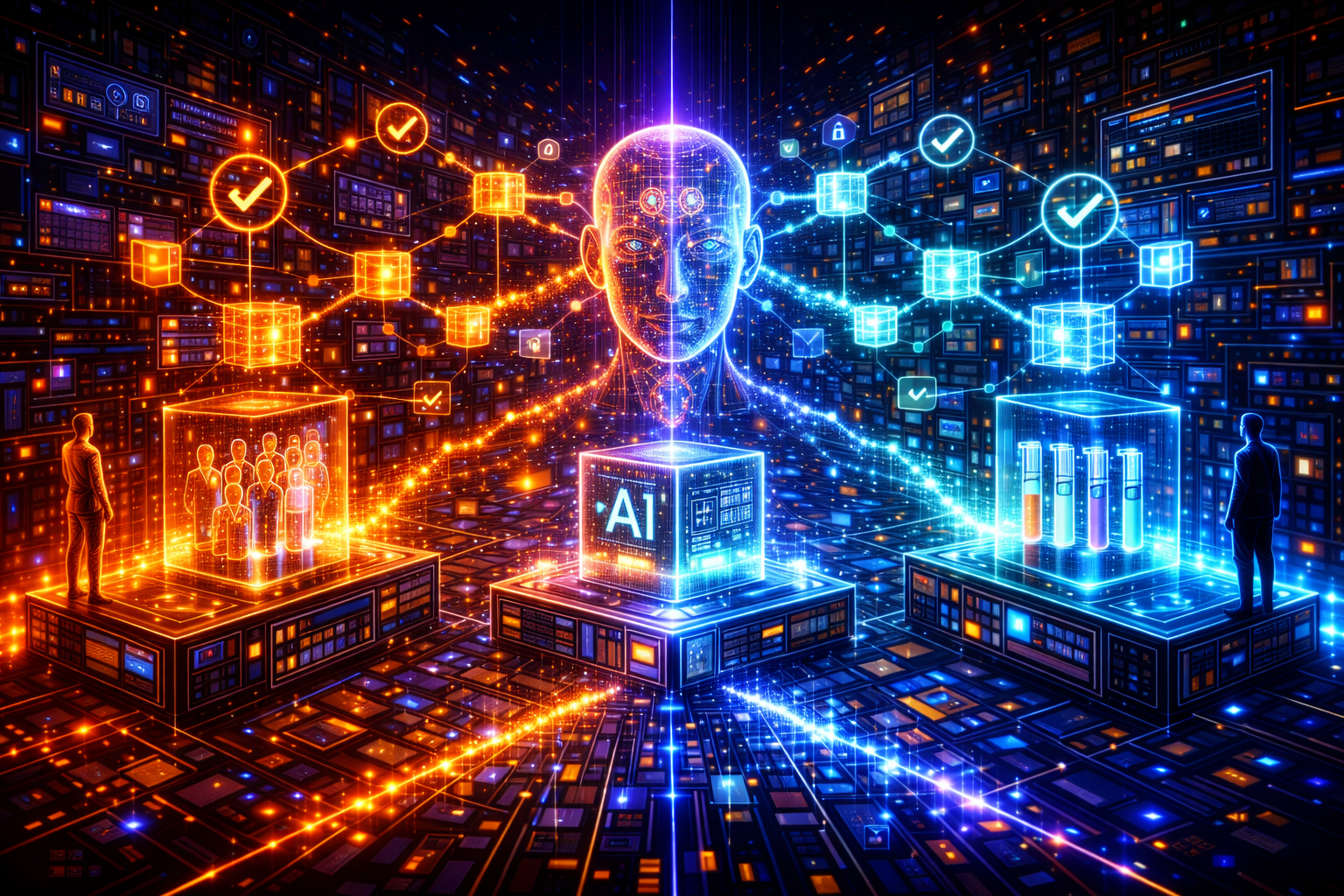
Synthetic data: Training AI on blockchain-verified datasets
Interview with Aisha Patel | Data Scientist | Co-founder of SynthDAO
AI models are only as good as their training data. But good data is expensive, often private, and increasingly contested legally. Aisha Patel believes synthetic data — artificially generated datasets — combined with blockchain verification could solve the data crisis. Her project SynthDAO is building the infrastructure.
2049.news: What's the data problem AI is facing?
Aisha Patel: Multiple problems converging at once.
First, real data has legal issues. Every major AI company is being sued over training data. Artists, publishers, individuals — everyone's claiming their data was used without consent. The legal foundation of modern AI is contested.
Second, the good data is running out. We've basically scraped the entire public internet. Models are being trained on AI-generated content, which degrades quality. The "data moat" is becoming a real competitive barrier.
Third, private data stays private. Healthcare, finance, enterprise — the most valuable data can't be shared due to regulations and competitive concerns. Models can't learn from it even though it would make them dramatically better.
Synthetic data addresses all three. It's legally clean — generated, not scraped. It's infinite — you can create as much as you need. And it can capture patterns from private data without exposing the actual data.
2049.news: How does synthetic data actually work?
Aisha Patel: The core idea is simple: use AI to generate training data for other AI.
You start with some real data — or even just statistical properties of real data. You train a generative model to capture the patterns, distributions, and relationships. Then you use that model to generate new samples that have the same statistical properties but aren't copies of any real data point.
For tabular data, this might mean generating synthetic customer records that have realistic age distributions, income correlations, purchasing patterns — but no record matches any real customer.
For images, you generate new images that look like the training domain but don't copy any specific image. Medical imaging is huge here — synthetic X-rays, MRIs, histology slides that train diagnostic AI without patient privacy concerns.
For text, you generate conversations, documents, or code that matches target distributions without copying copyrighted sources.
2049.news: Where does blockchain come in?
Aisha Patel: Trust and provenance.
If I sell you synthetic data, how do you know what you're getting? How do you verify it was generated correctly? How do you prove it doesn't contain leaked real data?
Blockchain provides verifiable provenance. We hash the generation parameters, the model used, the random seeds. Everything is recorded. You can trace any synthetic sample back to its creation process.
Smart contracts enable data marketplaces. Generators stake tokens on data quality claims. Buyers can challenge if data doesn't meet specifications. Automated verification where possible, arbitration where not.
Data DAOs govern generation policies. What constraints should synthetic data follow? What privacy guarantees are required? Token holders vote on standards that all marketplace participants follow.
2049.news: How do you ensure synthetic data is actually useful?
Aisha Patel: This is the hard part, honestly.
Bad synthetic data is worse than no data. If the generator doesn't capture important patterns, models trained on it will fail on real-world inputs. If the generator memorizes and regurgitates training data, you've defeated the purpose.
We use multiple validation approaches. Statistical tests verify that synthetic data matches target distributions. Machine learning utility tests train models on synthetic data and evaluate on held-out real data. Privacy audits check for memorization and potential re-identification.
The blockchain part helps here too. Validation results are recorded on-chain. Datasets build reputations over time. Bad generators get identified and filtered out. The market rewards quality.
2049.news: What about the "garbage in, garbage out" problem? If you generate synthetic data from biased sources, don't you just perpetuate bias?
Aisha Patel: You can perpetuate it, or you can fix it. Synthetic data actually gives you more control.
With real data, you're stuck with whatever biases exist in the world. Historical hiring data is biased? Too bad, that's what you have.
With synthetic data, you can explicitly adjust distributions. Want gender-balanced training data? Generate it. Want to oversample rare edge cases? Generate them. Want to remove correlations that shouldn't influence decisions? Remove them during generation.
This isn't magic — you need to know what adjustments to make, which requires understanding your domain and your fairness goals. But synthetic data makes interventions possible that are impossible with fixed real datasets.
We're building tools for "fairness-aware" synthetic data generation. Specify constraints — demographic parity, equal opportunity, whatever your requirements — and the generator produces data that satisfies them.
2049.news: What's the SynthDAO model specifically?
Aisha Patel: We're building a decentralized marketplace for synthetic data.
Generators are people or organizations with domain expertise and real data access. A hospital can generate synthetic medical records without exposing patient data. A bank can generate synthetic transactions for fraud detection training. They earn tokens for high-quality contributions.
Validators verify data quality. They run statistical tests, utility evaluations, privacy audits. They stake tokens on their assessments. Bad validations get slashed.
Consumers are AI developers who need training data. They pay tokens to access validated synthetic datasets. The market prices data based on quality, uniqueness, and demand.
Governance token holders vote on marketplace rules, quality standards, fee structures, and treasury allocation for ecosystem development.
We're live on testnet. Mainnet launch is planned for Q2 2025.
2049.news: What domains are you seeing the most demand?
Aisha Patel: Healthcare is enormous. Every hospital wants AI diagnostics. None can share patient data. Synthetic medical imaging, electronic health records, genomic data — massive demand, massive privacy requirements.
Financial services is close second. Fraud detection, credit scoring, risk modeling — all require data that banks can't share. Synthetic transactions that preserve fraud patterns without exposing customer information.
Autonomous vehicles need endless edge cases. Synthetic sensor data for scenarios that rarely occur but must be handled correctly. You can't wait for real crashes to train crash avoidance.
And increasingly, language data. The copyright lawsuits are pushing everyone toward synthetic text. If you can generate training data that's provably not derived from copyrighted sources, that's legally valuable.
2049.news: What are the risks or limitations people should understand?
Aisha Patel: Several honest caveats.
Synthetic data can't create information that doesn't exist in some form. If no one has data on a rare disease, we can't synthesize it from nothing. We're redistributing and recombining existing knowledge, not creating new knowledge.
Distribution shift remains a problem. If real-world patterns change, synthetic data trained on old patterns becomes stale. You need ongoing generation tied to evolving sources.
Validation is imperfect. We can test for known issues but might miss unknown ones. A synthetic dataset could have subtle problems that only manifest when models hit production.
Privacy isn't absolute. Sophisticated attacks might extract information about training data from synthetic samples. We're improving defenses, but the arms race continues.
And the market is early. Token economics are experimental. Quality standards are still forming. Early participants take real risks.
2049.news: Where does this go in the next five years?
Aisha Patel: Synthetic data becomes default for model training. Not supplementary — primary.
Legal pressure makes real data toxic. Synthetic becomes the safe harbor. Companies that can't prove their training data is clean face liability. Companies using verified synthetic data don't.
Data marketplaces mature. Standards emerge for different domains. Healthcare synthetic data gets regulatory blessing. Financial synthetic data gets compliance frameworks. The wild west period ends.
Generation quality reaches parity with real data for most applications. Not all — some domains will always need real data — but most common use cases work fine with synthetic.
And the economic model flips. Instead of "who has the most data," it becomes "who can generate the best synthetic data." Different competitive dynamics, different winners.
Aisha Patel is a data scientist and co-founder of SynthDAO, a decentralized marketplace for synthetic training data. She previously led ML data infrastructure at Spotify and holds a PhD in Statistics from Stanford.
Related posts