Tesla adds third-person camera view to self-driving system
Tesla adds third-person camera view to self-driving system
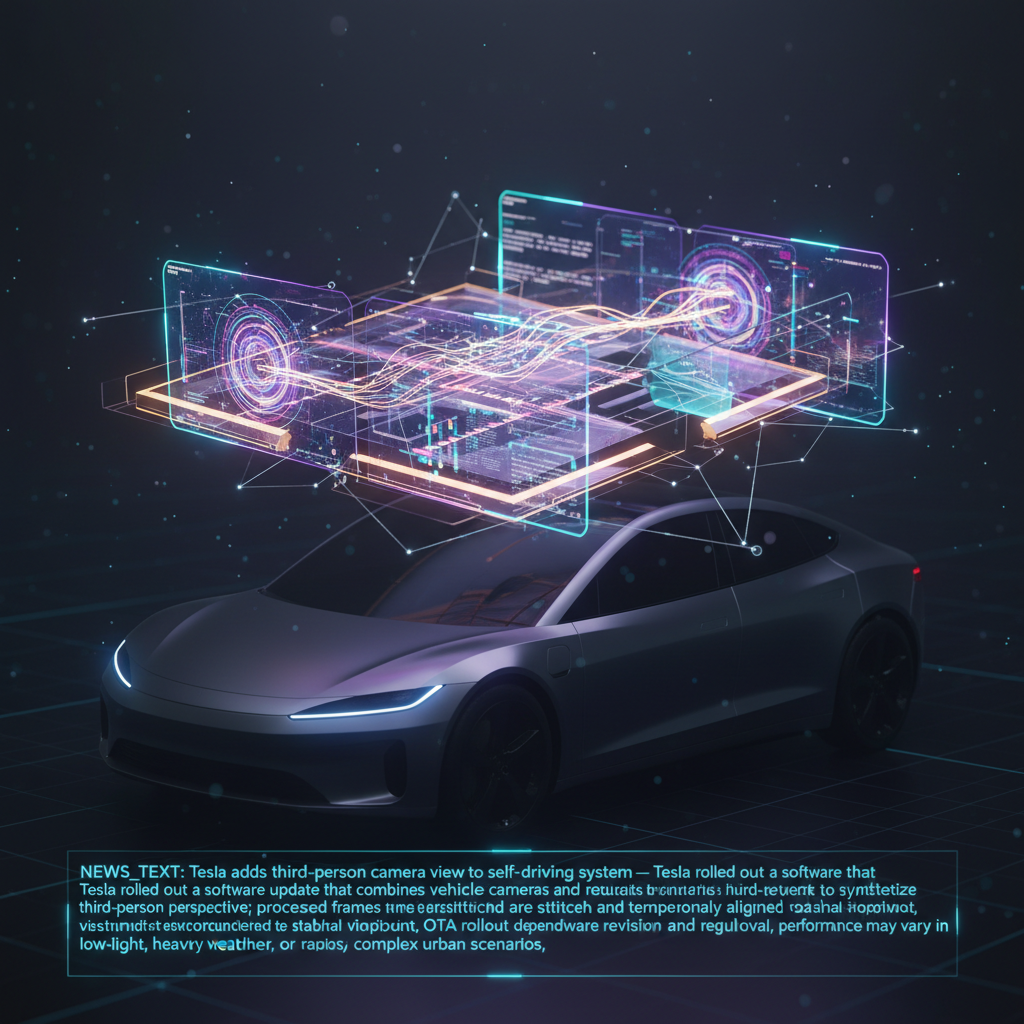
Tesla rolled out a software update that combines vehicle cameras and neural networks to synthesize a continuous third‑person camera perspective.
How the update works
The update uses multiple onboard cameras as inputs for convolutional and transformer-based neural models to render a reconstructed external viewpoint.
Processed frames are stitched and temporally aligned to produce a stable representation that gives drivers a bird's-eye-like orientation relative to surrounding traffic.
Limitations and rollout
Tesla will deploy the feature over-the-air to eligible vehicles, with availability determined by hardware revision and regional regulatory approval process.
Performance may vary under low-light, heavy weather, or complex urban scenarios where sensor occlusion or motion blur limit reconstruction accuracy.
Driver assistance context
Tesla emphasizes that synthesized external views are intended to augment driver situational awareness and not to replace direct attention to the road.
As with other advanced assistance features, drivers must maintain control and be prepared to intervene when system limits are reached.
Applications and next steps
Third-person synthesis can help drivers judge gap distances and lane positioning during complex maneuvers such as lane changes or tight urban turns.
Further iterations will likely focus on reducing latency, improving occlusion handling and integrating the view into driver monitoring workflows for safer operation.
Related posts