Hermes Agent emerges as independent agent framework
Hermes Agent emerges as independent agent framework
Hermes Agent from Nous Research positions itself as an alternative agent framework with broad model compatibility and persistent memory features.
Overview
According to usage metrics, Hermes Agent has 155K GitHub stars and ranks number 1 on OpenRouter by token usage globally.
Design and defaults
Hermes emphasizes persistent defaults, built-in memory management and a more autonomous agent behavior compared with explicit-control frameworks like OpenClaw.
Internal components
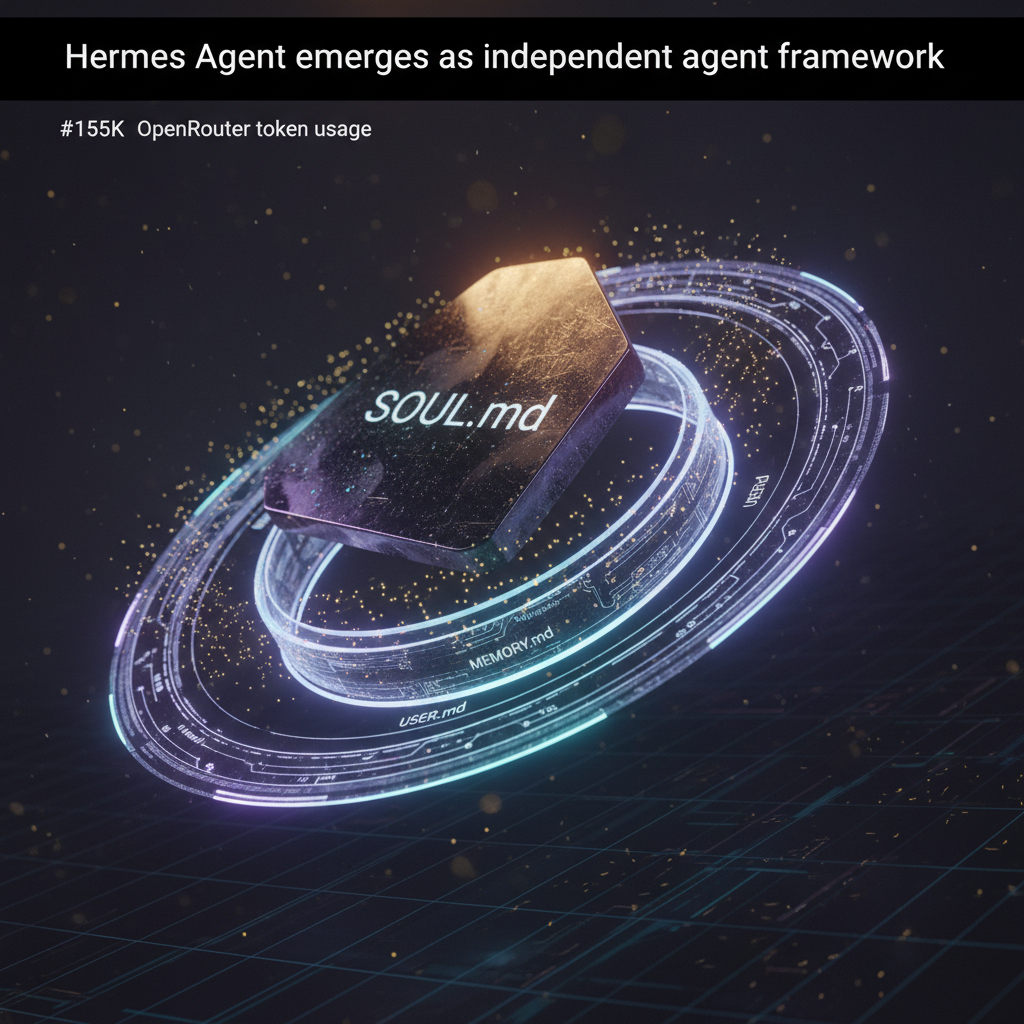
The framework loads a personality file named SOUL.md first, which sets tone, style and hard constraints for agent responses.
Memory is implemented across three layers, using MEMORY.md and USER.md with capacities of 2200 and 1375 characters injected per session.
Session history is indexed via SQLite with full-text search and offers access to unlimited historical entries on demand, plus eight external memory providers.
Out of the box, Hermes includes 123 skills covering GitHub, Obsidian, Google Workspace, Linear, Notion, browser automation, image generation and text-to-speech.
Funding and claims
The Nous Research team has disclosed a funding round totalling $70 M, with Paradigm among reported investors supporting further development.
Project claims indicate token cost reductions over time, citing up to a 90% decrease in operational spending under typical workloads.
Getting started
Installation can begin with a single terminal command; after that, run hermes setup to choose provider, model and messenger options.
A free-tier option exists via OpenRouter, which exposes many free models including openai/gpt-oss-120b:free, google/gemma-4-31b-it:free and nousresearch/hermes-3-llama-3.1-405b:free.
Migration from OpenClaw is supported with the command hermes claw migrate., simplifying transfer of workflows and assets.
Portability and ecosystem
Hermes aims to decouple agent workflows from single-provider policies by routing requests through a unified CLI gateway and supporting over 300+ models via a single access point.
- Skill repositories: community and vendor skill sets can be adapted for Hermes usage.
- Extensibility: agents can create new skills autonomously after solving complex tasks.
Summary
Hermes presents itself as a flexible, memory-focused agent framework prioritizing portability, cost efficiency and a rich skill ecosystem across many models and providers.
Related posts